To Give is to Gain. To Dare is to Build.
 In Makueni County, Kenya the rains are a negotiation.
Some years they come fully, and the land responds. Other years they arrive late, or partially, or not at all, and families like Esther Kaleli’s absorb the loss quietly, the way people do when they have no other choice. Esther had watched enough failed seasons to know that the land does not make promises. She had learned to hold onto what she had and trusted very little she could not see with her own eyes.
Boniface came to her village.
He was a community mobiliser, and he had a question she had never been asked before: what would it mean to you, to know that if the rain failed, you would not lose everything?
Esther listened. She was not convinced. But she went home and told her husband.
He said: we have never participated in such a programme before. But let us try it; it might help our family.
So, Esther gave the first thing, her trust. Not fully, not without doubt, but enough. They registered.
She gave the second thing, her money. A premium drawn from a household budget that had no room for experiments. Hard-earned, carefully counted, handed over to a system she could not fully explain to her neighbours, run by people she would never meet, tied to data she could not see. She paid for it anyway.
The hardest give came last, patience.
She watched the sky and said nothing to her neighbours, not wanting to speak too soon about something she could not yet prove.
The rains of 2024 arrived, and then they didn’t. The pastures dried. The vegetation index that satellites had been quietly tracking all season crossed the threshold, and the system did what it had promised. The money found her before she had finished waiting. KSh 12,000 for her household.
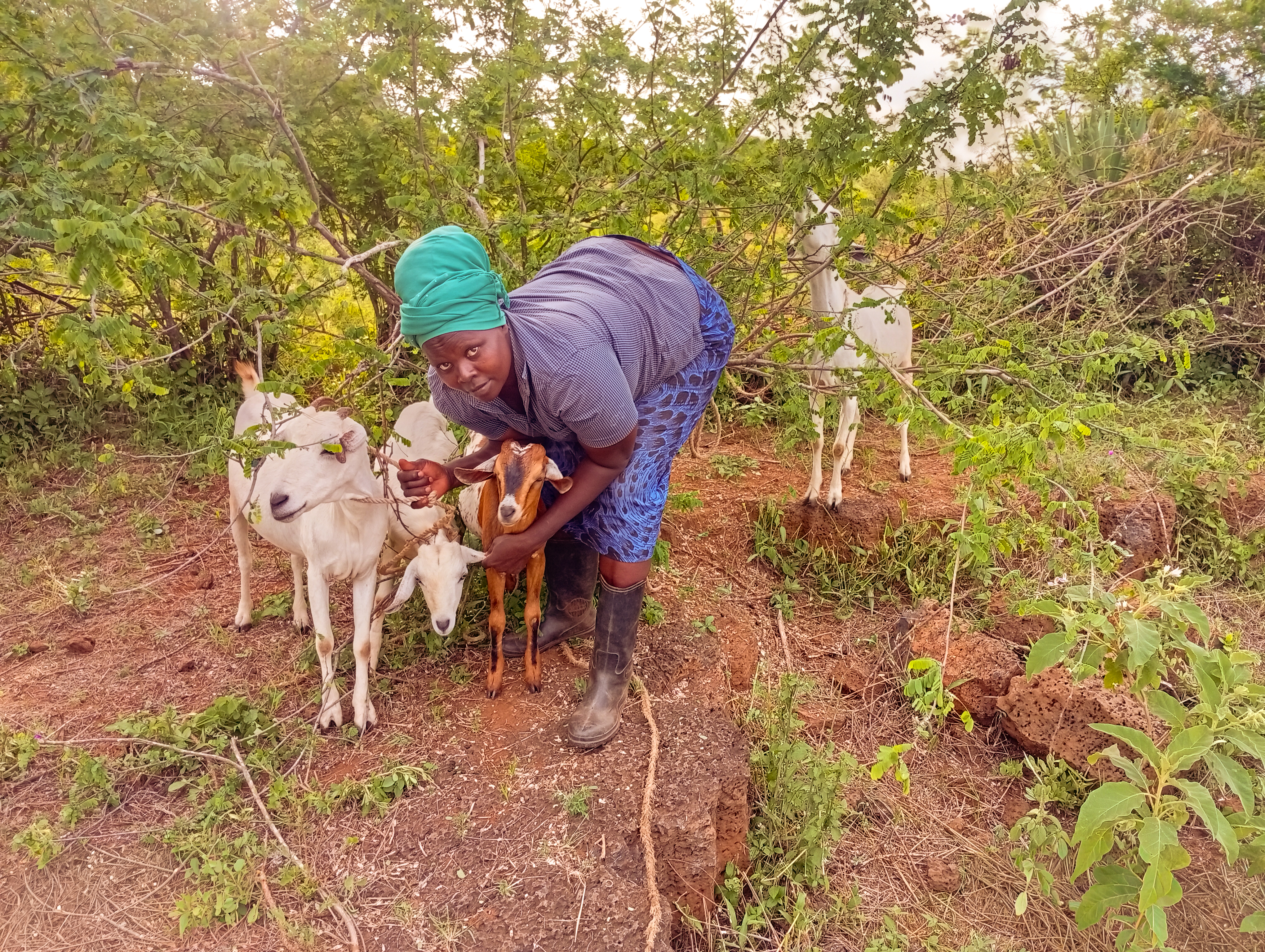
Esther and her husband went to the market and bought two goats. It did not take long. Both goats gave birth, twins. Two became six. And Esther, who had given everything she had into a system she could not see, watched her herd grow from a payout that arrived before she even knew to ask for it.
She re-enrolled.
A mid-season payment came, KSh 5,000. Then another payout of KSh 8,000. With each payout, the household moved forward; another goat, animal feed, school fees covered; daily needs met. And Esther, who once held her trust close and her money closer, is now the one walking to her neighbours’ compounds to tell them what she once doubted herself.
She had given trust, money, and patience, the three things that cost the most when you are not sure what you will receive in return.
And the system gave back, with interest.
“At first, I thought it was not something serious. But now I understand how important it is. It truly helps farmers.” — Esther Kaleli, Makueni County, Kenya.
Esther said those words sitting in a compound that holds six goats where there were none three years ago. She is not the only one.
Across Ethiopia, Somalia, and Kenya, women make up over 55% of DRIVE beneficiaries. Women who gave before they could see what they would gain. Women who brought the idea home, registered quietly, and spent entire seasons watching the sky, waiting to see if the system meant what it said.
It did.
This Women’s Month, we do not celebrate them as recipients of good fortune. We celebrate them as the architects of their own resilience, women who made a decision, held their nerve through a drought, and came out the other side standing.
The De-Risking, Inclusion and Value Enhancement of Pastoral Economies project, DRIVE, implemented alongside the governments of Ethiopia, Somalia, and Kenya and supported by the World Bank, was built on one belief: that inclusion is not charity. It is a system and systems, when built right, compound. And when you build the right index architecture, families rebuild their herds, keep their children in school, and face the next season without fear.
To every woman who dared to give before she could see the gain, this was built for you.
To give is to gain. To dare is to build.